
API Tech Transfer Checklist: 28 Checks Before Scale-Up at a CDMO
API technology transfer to a CDMO involves dozens of handoffs between R&D, the receiving site, Quality and Regulatory Affairs. This checklist lists what needs to be in place before scale-up batches, with a suggested owner and the evidence that shows each item is actually done.
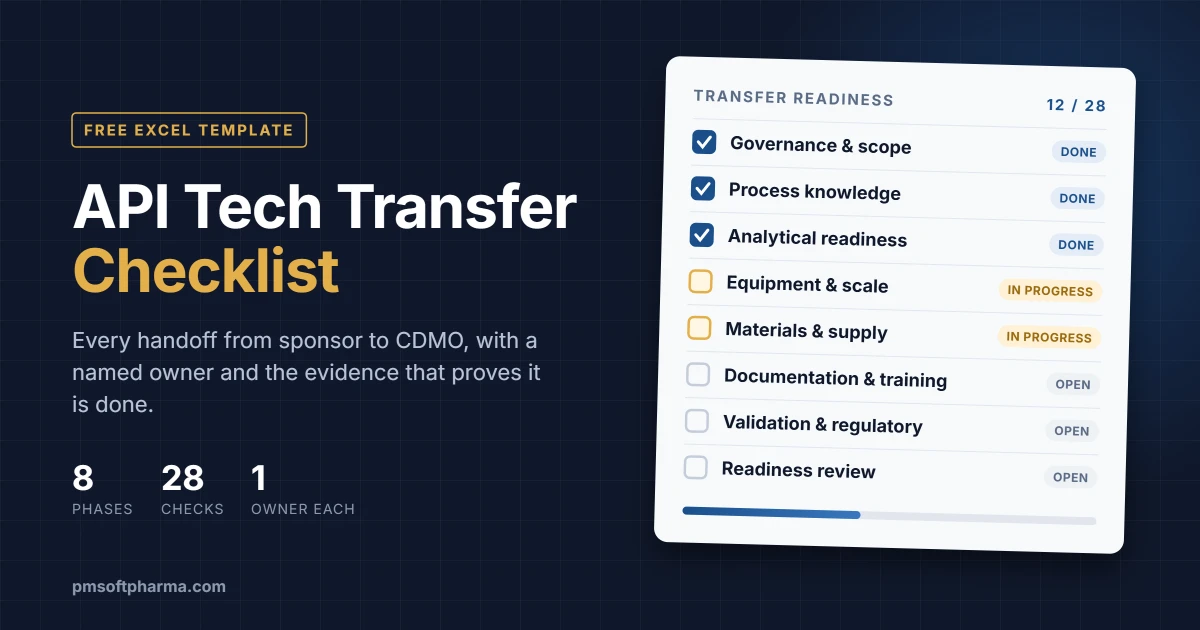
Download the free Excel version with status tracking, due dates and a progress count. No sign-up needed.
This is a project-coordination aid. It does not replace your quality system, SOPs, quality agreement or regulatory advice.
How to use this checklist
- Agree it at kickoff: review the list with the CDMO and remove items that do not apply.
- One owner per item: name a single accountable person, not a team.
- Close on evidence: an item is done when the receiving side accepts the evidence, not when the sender says it is finished.
- Review weekly: check open items against the launch or filing date.
1. Governance and scope
Set up who decides, who coordinates and what “transferred” means before technical work starts.
| Checklist item | Owner | Evidence of completion |
|---|---|---|
| Named transfer coordinator on both sponsor and CDMO side | Sponsor PM / CDMO PM | Project charter or RACI naming both coordinators |
| Transfer scope and success criteria agreed | Sponsor PM, QA | Approved transfer plan or protocol |
| Integrated plan linked to the launch or filing date | Sponsor PM | Baselined schedule with critical path |
| Decision and escalation route agreed | Sponsor PM / CDMO PM | Governance calendar and escalation matrix |
| Quality agreement in place | QA (both sides) | Signed quality agreement |
2. Process knowledge
Transfer the reasoning, not just the documents.
| Checklist item | Owner | Evidence of completion |
|---|---|---|
| Process description includes the rationale for operating ranges | R&D | Process package / development report |
| Difficult steps, observed failure modes and troubleshooting history documented | R&D | Process risk assessment and lessons log |
| Knowledge does not depend on one person; structured walk-throughs held and recorded | R&D / CDMO technical | Session records and Q&A log |
| Every open technical question has an owner and a due date | Sponsor PM | Q&A log with verified closure |
3. Analytical readiness
The receiving lab must be able to test the product before batches depend on it.
| Checklist item | Owner | Evidence of completion |
|---|---|---|
| Method list and transfer approach agreed for each method | Analytical (both sides) | Analytical method transfer protocol |
| Reference standards and impurity markers available at the receiving site | Analytical | Inventory list with CoAs |
| Method transfer completed against agreed acceptance criteria | Analytical / QA | Approved method transfer report |
4. Equipment and scale
Plant equipment behaves differently from the lab. Assess the differences before declaring readiness.
| Checklist item | Owner | Evidence of completion |
|---|---|---|
| Equipment comparison covers mixing, heat removal, charging, filtration and drying | CDMO technical | Equipment gap assessment |
| Scale-up risks assessed and supporting studies planned | R&D / CDMO technical | Scale-up risk assessment and study plan |
| Need for engineering or demonstration batch decided | Technical leads / QA | Recorded decision with rationale |
| Cleaning and cross-contamination assessed for shared equipment | CDMO QA | Cleaning assessment |
5. Materials and supply
Late materials are one of the most common reasons transfer batches slip.
| Checklist item | Owner | Evidence of completion |
|---|---|---|
| Raw material specifications and approved suppliers aligned | Supply chain / QA | Specifications and supplier approvals |
| Long-lead materials ordered against required-by dates | Supply chain | Purchase orders tracked against the plan |
| Quantities of starting materials and intermediates confirmed for all planned batches | Sponsor PM / Supply chain | Material requirements plan |
6. Documentation and training
Agree what “complete” means for every deliverable so handoffs do not bounce back.
| Checklist item | Owner | Evidence of completion |
|---|---|---|
| Documentation package list agreed, with acceptance criteria for each item | Sponsor PM / QA | Deliverables register |
| Master batch records drafted and reviewed | CDMO / QA | Approved master batch record |
| Operators and analysts trained on the transferred process | CDMO | Training records |
7. Validation and regulatory
Quality and regulatory decisions stay with the designated specialists. The plan makes sure they happen on time.
| Checklist item | Owner | Evidence of completion |
|---|---|---|
| Validation strategy agreed (approach and number of batches) | QA / Technical leads | Validation plan or protocol |
| Regulatory impact assessed (site change, variation or supplement needs) | Regulatory Affairs | Regulatory impact assessment |
| Change control raised and tracked to closure | QA | Change control record |
8. Readiness review
A green schedule is not readiness. Review the evidence.
| Checklist item | Owner | Evidence of completion |
|---|---|---|
| Evidence reviewed: completed items, open technical work and unresolved deviations kept separate | Sponsor PM / QA | Readiness review minutes |
| Every open item has an owner and a decision date | Sponsor PM | Action log |
| Go / no-go decision made by the designated approvers | QA / Technical leads | Signed readiness decision |
Four key risks in API tech transfer, and how to avoid them
Most transfer delays stem from coordination, not chemistry. They usually start as blind spots: issues that are rarely owned until they surface at scale-up. The checklist helps bring these into focus early:
- Documents that lack the reasoning behind them
- Knowledge held by a single person
- Equipment mismatches that were never assessed
- Handoffs without agreed acceptance criteria
We explain each in API Technology Transfer to a CDMO: 4 Risks & How to Fix Them.
Frequently asked questions
What should an API tech transfer checklist include?
It should cover governance and scope, process knowledge, analytical method transfer, equipment and scale assessment, materials, documentation and training, validation and regulatory impact, and a final readiness review. For each item, record an owner and the evidence that shows it is complete.
Who owns the tech transfer checklist: the sponsor or the CDMO?
Both sides contribute, but one named coordinator should own the integrated checklist and plan. Individual items are owned by the relevant function on either side, and quality and regulatory approvals remain with the designated specialists.
Is this checklist enough for GMP compliance?
No. It is a project-coordination aid. It helps teams see gaps early, but it does not replace your quality system, SOPs, quality agreement or regulatory advice.
Track it live instead of in a spreadsheet
A spreadsheet works for one transfer. When you run several with different CDMOs, PMSoft Pharma keeps owners, due dates and evidence in one live view. Request a demo.
Header photo: Jakub Żerdzicki, Unsplash.