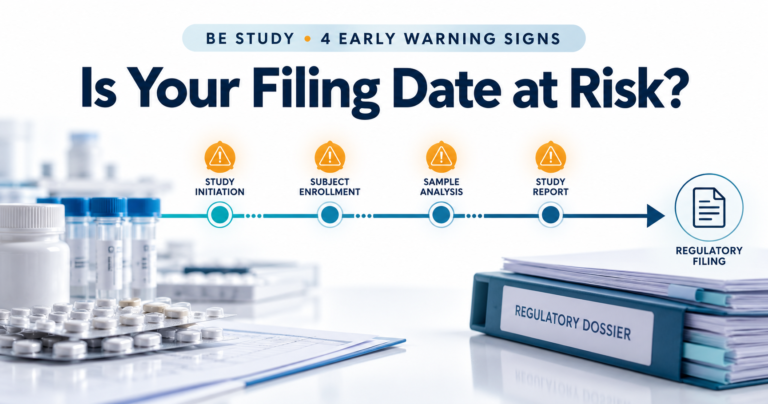

One Product. 15 Markets. 60+ Deadlines. Is Your RA Team Still Tracking Them in Excel?
Updated: 19 October 2026 — revised guidance references and project-management recommendations.
Ask a Regulatory Affairs Head how many deadlines their team carries this year and you will rarely get a number. You will get a sigh, and then a spreadsheet.
That sigh is the problem this post is about. Not the science of registration, but the management of it.
A missed regulatory deadline is not simply an administrative delay. It can delay approval, renewal or variation implementation – and ultimately affect the ability to sell in a market.
The arithmetic nobody writes down
Consider an illustrative planning scenario: one generic product with registrations or applications across 15 countries. Depending on its status and local requirements, each country record may include:
- a filing date and an agency review clock
- agency queries and their specified response deadlines, where applicable
- sample requests with their own due dates
- renewal, retention or other lifecycle obligations according to the applicable market and authorisation
- assessment of vendor, process or packaging changes to determine the applicable regulatory reporting or approval route
For illustration, if each of the 15 country records carries four dated events during a year, the team manages 60 dates for that product. The four events could be a planned submission, an agency response, a sample delivery and a lifecycle action. This is a workload example, not a regulatory minimum or an industry benchmark. Actual workload depends on the portfolio, application stage and market requirements.
In project management terms, this is not a list. It is a programme of linked workstreams with external deadlines, internal preparation dates and forecast milestones. These date types should remain distinct.
Why spreadsheets hold up – at first
Spreadsheets work when one person owns them and the portfolio is small. Every RA team starts there for good reasons: they are familiar, flexible and quick to change.
The trouble starts when the team grows, the market list expands, and the same registration begins appearing in multiple files.
The real RA tracking problem
Fragmented Data → Hidden Deadlines → Unclear Ownership → Reactive Reviews → Commercial Risk
1. There is no single truth
The filing tracker says “under review”. The query sheet says “query open”. The Head of RA sees a third version in last month’s presentation. Each may have been correct on the day it was updated.
2. Deadlines live in inboxes
Agency letters arrive by email. The due date enters the tracker only when someone records it. Until then, the most urgent date in the department may exist in one person’s mailbox.
3. Nobody sees what is coming
A basic spreadsheet without configured alerts or workflow depends on someone checking it. Spreadsheets can support automation; the issue is whether reliable reminders, ownership and escalation are actually implemented. Teams can discover approaching expiries too late for comfortable action.
4. Ownership becomes blurred
Who updates the status after submission – the executive who filed, the manager who approved, or the local agent? In a shared sheet, accountability can become unclear.
5. Management cannot get an answer quickly
“Where can we sell this product today?” sounds simple. In a spreadsheet-driven environment, answering it may require reconciling several files – and the answer can become outdated quickly.
What a project manager would do differently
Treat the registration portfolio the way a PMO treats a programme:
- One record per registration. One product in one country, with its status, dates and owner. Queries, samples, variations and renewals link back to that record.
- Milestones that alert. Configure reminders backwards from the applicable submission deadline, allowing time for preparation and review. For example, EU centralised renewal applications generally need submission at least nine months before expiry; reminders starting only 180 days before expiry would be too late. Query reminders should follow the deadline specified for that procedure.
- Clear ownership. Every record has a named owner and every hand-off is visible.
- Exception-based reviews. Weekly RA meetings focus on red and amber items. Green registrations do not consume unnecessary airtime.
- One picture for management. A product-by-country view answers “where can we sell?” at a glance.
None of this needs new science. It needs the same discipline applied to any complex programme: one source of truth, visible milestones and accountable owners.
Has your RA tracking outgrown Excel?
Try this simple test. Answer these three questions without opening more than one file:
- Which registrations expire in the next 180 days?
- Which agency queries are due in the next ten days, and who owns each?
- In how many countries is your newest variation approved?
If any answer takes more than five minutes, your tracking may have outgrown the spreadsheet. The risk is not only inefficiency. A missed regulatory date can have a direct business consequence.
Where PMSoft Pharma helps
PMSoft Pharma brings project and programme management discipline to Regulatory Affairs – not another standalone regulatory system.
We help pharma RA and project teams structure registration portfolios around ownership, milestones, alerts, exceptions and management visibility, using Microsoft 365 tools that many organisations already own.
If your team is chasing deadlines rather than tracking them, talk to us about an RA Registration Tracking Health Check and see what one-screen visibility across registrations could look like.
Market-specific requirements belong in the tracker
A single global renewal interval is unsafe. Under the EU centralised procedure, an initial marketing authorisation is generally valid for five years; after renewal, validity is normally unlimited unless an additional five-year renewal is required. Conditional authorisations follow a separate process. See EMA renewal guidance.
For each record, retain the authority, authorisation type, applicable obligation, deadline source, source-check date and accountable Regulatory Affairs owner. Keep statutory dates separate from internal target dates. Alerts support the process; the responsible specialist confirms the current requirement.
Explore the RA Tracker or request a workflow discussion.