Pharma Project Management Maturity: Is Your Organisation Mature or Merely Process-Heavy?
Walk into most mid-size pharmaceutical or chemical organisations and you’ll find no shortage of process infrastructure. Yet, evaluating true pharma project management maturity reveals a common disconnect: SOPs govern every stage-gate, trackers log milestones by the dozen, but tech transfers still slip and regulatory dates get pushed back. The gap between looking mature on paper and achieving genuine operational maturity is where most delivery risk actually lives.”
Why pharma projects appear mature
The appearance of maturity is easy to build and easy to mistake for the real thing.
- Defined SOPs exist for nearly every stage of the product lifecycle, from formulation development through batch release.
- Multiple review meetings run each week: technical reviews, quality reviews, steering committee check-ins.
- Documentation is detailed, often because regulatory expectations force it to be. Deviation reports, change controls, and batch records are thorough by necessity.
- Dashboards track timelines, budgets, and milestones, usually built in whatever PM tool or spreadsheet each function has adopted independently.
None of this is wrong. It’s necessary. But compliance activity and documentation discipline are not the same thing as project governance. An organisation can pass every audit and still not know, with any confidence, when a product will actually launch.
Where maturity gaps remain
The gaps show up in the spaces between the process, not inside it.
- Functions maintain separate schedules. Formulation, regulatory, manufacturing, and quality each track their own timeline, often in their own tool, with no shared master schedule that shows how one function’s delay compounds into another’s.
- Dependencies surface late. A tech transfer delay in manufacturing scale-up often isn’t visible to the regulatory team until it directly threatens a submission date, by which point the options for recovery are limited.
- Decisions lack clear ownership. A stage-gate review can end with “more data needed” and no named owner for getting that data, no deadline, and no escalation path if it stalls.
- Risks are recorded but not actively governed. Risk registers exist and get updated before every steering committee, but the same risks appear meeting after meeting without a mitigation actually closing them out.
- Portfolio priorities shift frequently, often driven by a single urgent product, and the ripple effect on resourcing for every other active project goes unmanaged.
- Lessons don’t travel. A CAPA from one CDMO tech transfer rarely makes it into the playbook for the next one, so the same avoidable delay gets rediscovered by a different team a year later.
Individually, each gap looks minor. Together, they explain why organisations with strong documentation still miss dates they were confident about three months earlier.
What a maturity assessment examines
A genuine project management maturity assessment doesn’t audit whether procedures exist. It examines whether they function as an integrated system:
- Governance and decision cadence – whether stage-gate reviews produce decisions with owners and dates, not just discussion
- Schedule and dependency visibility – whether there is one integrated view across functions, or several disconnected ones
- Risk and issue management – whether risks are actively retired or simply carried forward
- Resource and capacity planning – whether people are allocated against real project demand or against whoever shouts loudest
- CAPEX/OPEX control – whether budget tracking is tied to project milestones or maintained as a separate finance exercise
- Stakeholder transparency – whether leadership sees the same picture of project health that the project team sees
- Benefits and outcome tracking – whether anyone checks, after launch, whether the project delivered what it promised
- Institutionalisation across projects – whether lessons from one project structurally change how the next one is run
The five maturity levels
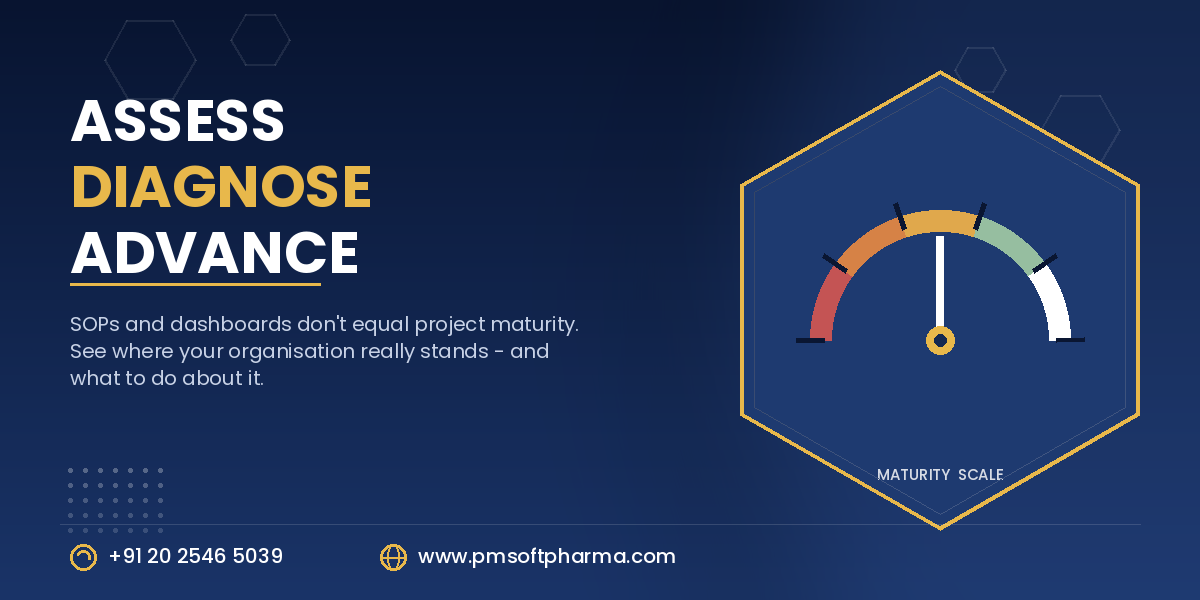
Most organisations sit somewhere on a five-level scale, and the honest answer is rarely where leadership assumes:
- Reactive – projects are managed issue by issue, with little forward visibility
- Defined – processes and templates exist, but application is inconsistent across teams
- Controlled – processes are consistently applied and reviewed
- Integrated – dependencies, resourcing, and decisions are managed across functions as one system
- Optimised – the organisation actively uses data and lessons learned to improve delivery predictability over time
The jump from Defined to Controlled is where most pharma organisations get stuck. Documentation discipline is high, but the cross-functional integration that would move them to Controlled or Integrated hasn’t happened.
Assessment outcome
A structured assessment should leave you with more than a diagnosis. It should produce:
- A current maturity profile, scored against the areas above, not a single vague label
- A clear picture of where documented practice and operating practice diverge
- A prioritised improvement roadmap, sequenced by what will actually move delivery predictability, not by what’s easiest to fix
- A measurable target maturity level, with a realistic timeframe attached to it
Without these four outputs, an assessment is just another audit that confirms what everyone already suspected and changes nothing.
Project-management maturity is not measured by how many processes exist. It is measured by how consistently the organisation converts decisions into predictable project outcomes.