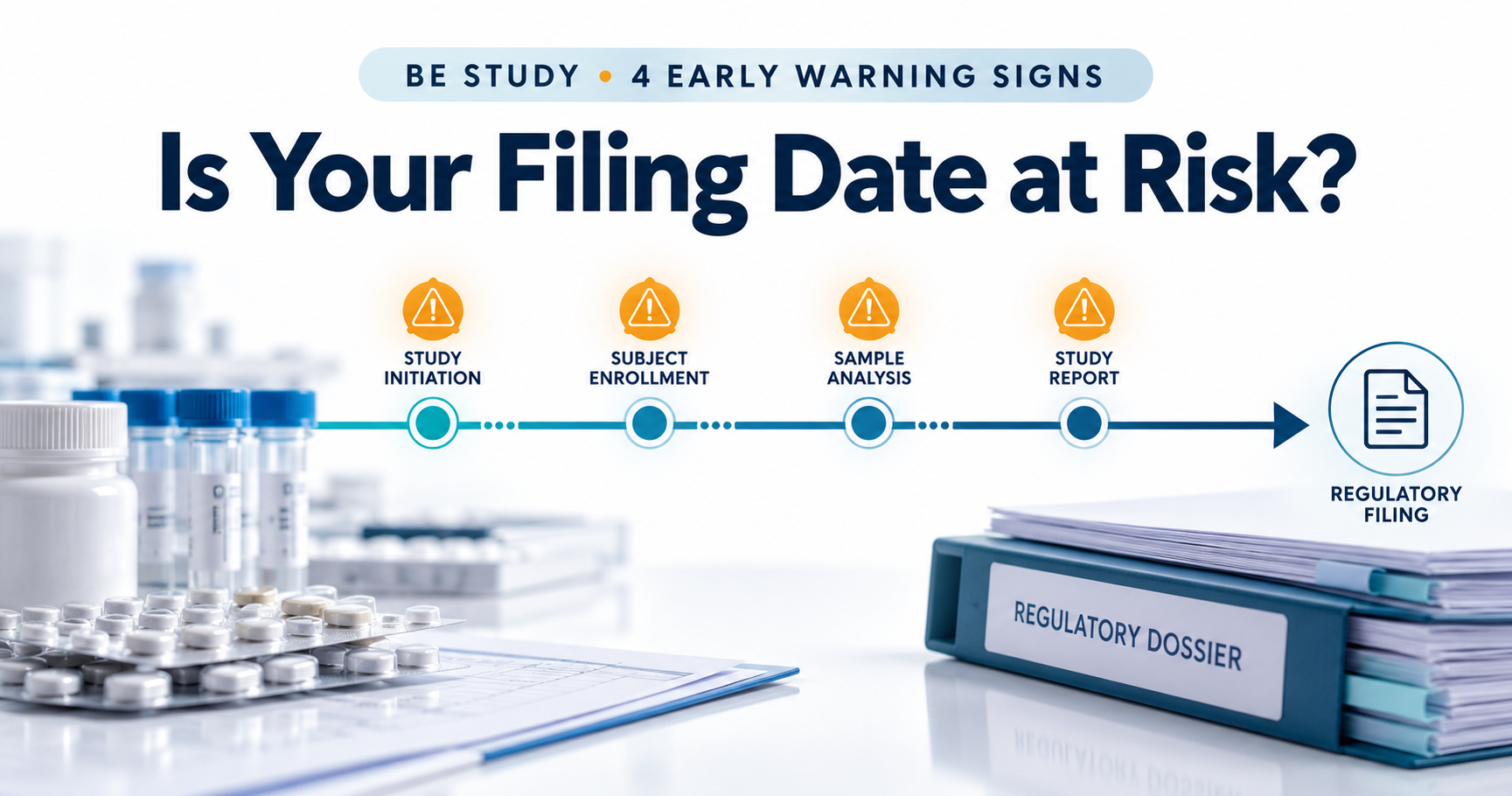
Is Your BE Study Delaying Regulatory Filings? 4 Early Warning Signs.
BE study delays can put a regulatory filing date at risk long before the project dashboard turns red. A reference product is still being sourced. Protocol comments remain open. The contract research organisation (CRO) reports that work is progressing, but nobody can show what the latest forecast means for dossier readiness.
For pharma NPD teams, the management challenge is the connection between study prerequisites, execution, report availability and the submission plan. A study milestone can look achievable while the time available for downstream review quietly disappears.
These four early warning signs help project managers, Regulatory Affairs teams and development leaders identify that exposure before a missed date becomes a filing delay.
1. Reference-product readiness has no confirmed date
“Procurement initiated” does not mean the reference product will be available when the CRO needs it. Sourcing, receipt, documentation, suitability checks and transfer to the study location can involve different owners.
Early warning: the plan contains a purchase-order date, but no confirmed date for receipt and acceptance at the required location. The study-start milestone stays unchanged despite uncertainty in supply.
Filing impact: a missed material-readiness date can affect a reserved study slot. The next available slot may move the report date beyond the time allowed for regulatory review.
Management action

track reference-product readiness as a sequence of owned deliverables.
Record the required-by date, supplier commitment, outstanding checks and latest accepted-delivery forecast.
Regulatory and study specialists should confirm comparator suitability for the target market; purchasing availability alone is insufficient.
Ask in the next review: “What evidence supports the date when the correct reference product will be ready for this study?”
2. Approvals appear as one activity
A single line called “Study approvals” hides the work required to reach an executable protocol. Sponsor review, CRO responses, document revisions, ethics review and any applicable authority permissions may follow different routes and timelines.
Early warning: one activity covers every approval, has no intermediate outputs and shows progress based on documents circulated rather than decisions received.
Filing impact: an unresolved comment or missing submission input becomes visible only near the planned study start. The team then discovers that the remaining approval path takes longer than the available schedule allowance.
Management action
separate the applicable review and approval steps.
Define the owner, required input, submission date, expected response and completion evidence for each.
Distinguish internal commitments from external review assumptions, and keep revision cycles visible.
Ask in the next review: “Which approval is still open, what is blocking it, and what date can we now support?”
3. The CRO schedule is disconnected from the filing plan
A CRO may manage its work to an agreed operational schedule while the sponsor tracks a different milestone in the NPD master plan. Without linked handoffs, both schedules can appear on track while referring to different definitions of completion.
Early warning: the CRO tracks clinical completion, the project team tracks report receipt, and Regulatory Affairs expects a reviewed package ready for dossier use. These dates are treated as interchangeable.
Filing impact: bioanalysis, data queries, statistical work, report preparation, sponsor review and finalisation may sit between clinical completion and filing readiness. Missing those steps creates an unrealistic submission forecast.
Management action
connect the agreed CRO deliverables to the sponsor’s integrated schedule.
Include applicable downstream activities, review time and document handoffs.
Make the acceptance criteria for each milestone explicit.
Keep stability and other dossier prerequisites visible alongside the BE workstream. They have their own evidence and timing needs; completing the BE study does not by itself establish that the full submission package is ready.
Ask in the next review: “Does the CRO’s latest report forecast still support our reviewed-dossier date?”
4. Progress is reported without baseline or forecast
“Study ongoing” and “80% complete” describe activity, but they do not explain whether the filing date remains achievable. Percentage completion is especially misleading when an unresolved issue blocks the next dependent task.
Early warning: reviews show status comments and a green indicator, but omit baseline dates, actual completions, remaining work, forecast dates and available schedule float.
Filing impact: slippage consumes review time without triggering a decision. When the final report arrives late, Regulatory Affairs inherits a compressed preparation window.
Management action
review baseline versus forecast at each key handoff.
Identify the controlling dependency, remaining float and decision required.
Where recovery is proposed, record the owner and evidence supporting the revised dates.
Retain the original baseline so reforecasting does not erase the variance.
Ask in the next review: “What changed since the last review, and how many days of filing-date protection remain?”
Turn the warning signs into a weekly review
Use one integrated view covering material readiness, applicable approvals, CRO deliverables, sponsor review and dossier readiness. For each milestone, show the accountable owner, baseline date, latest forecast, variance, blocker and next decision.
Escalate when a forecast threatens the agreed handoff or consumes the schedule allowance needed by a downstream team. Set thresholds appropriate to the project; avoid treating a universal number of days as a regulatory rule.
Illustrative example: a reference-product handoff slips by ten working days, while only five working days of float remain on the linked path. If subsequent durations and dependencies stay unchanged, the path finishes five working days later. The team needs to assess a feasible recovery or revise the filing forecast. This is schedule logic, not a prediction of study outcome or authority review time.
What should be checked before the next filing commitment?
Confirm that material readiness is evidenced, approval steps are individually visible, CRO handoffs are linked to the sponsor plan, and progress reports include forecast impact. Also confirm that other submission prerequisites remain achievable.
A BE study can become a filing bottleneck through missed handoffs as well as through technical issues. Earlier visibility gives the team time to make a supported decision while options still exist.
PMSoft perspective: institutionalisation means these checks happen consistently across projects, rather than depending on an individual project manager. A focused PM maturity assessment can examine whether dependency planning, evidence-based reporting and decision cadence work in practice—from Concept to Commercialization.
To discuss gaps in your pharma NPD planning and review process, visit PMSoft Pharma.
Regulatory context and references
The four warning signs above are project-management recommendations. The applicable study design, permissions and submission evidence depend on the product, pathway and target market.
For US ANDA planning, FDA’s guidance on bioequivalence studies with pharmacokinetic endpoints addresses BE information in ANDAs, amendments and supplements. FDA also provides separate guidance on stability testing for ANDAs. Regulatory Affairs should confirm which current guidance and product-specific recommendations apply to the proposed submission.