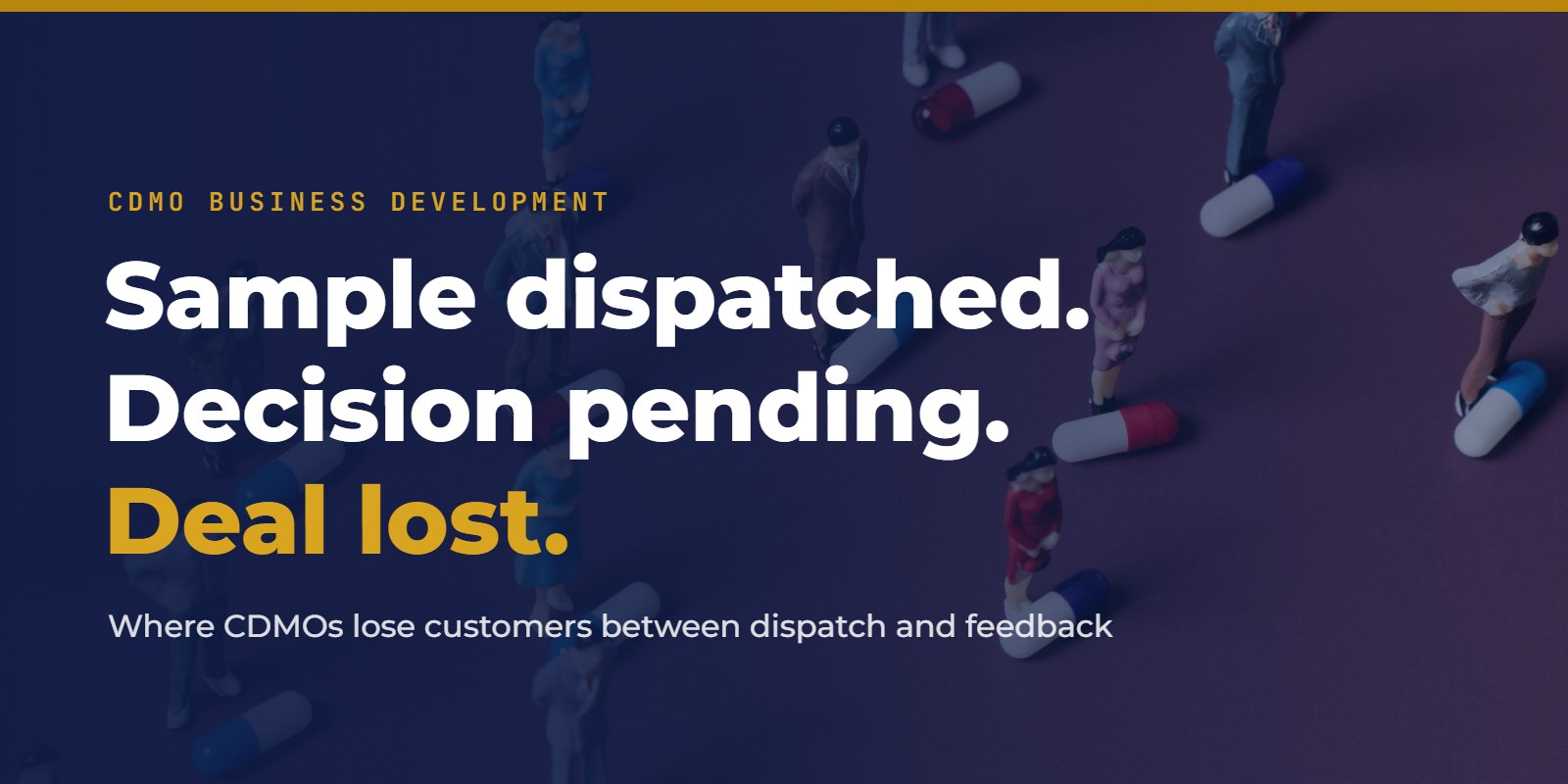
Sample dispatched. Decision pending. Deal lost.
A customer requests a 50 g sample of an advanced intermediate. Your R&D team prepares it to the agreed specification, QC releases it with a Certificate of Analysis, and logistics ships it on a Friday. Business development confirms the dispatch by email.
Then nothing happens for six weeks.
When the customer finally replies, it is to say they have selected another supplier. The reason is rarely price. More often, a technical query raised during their evaluation was answered late, answered incompletely, or not answered at all.
This is one of the most common, and least visible, ways in which CDMOs lose business. The sample has left the site, the enquiry still shows “in progress”, and no one is accountable for what happens next. (Illustrative scenario, not client data.)
Where do the communication gaps arise between dispatch and decision?
Between the day a sample is dispatched and the day the customer decides, responsibility passes through four handoffs. In most CDMOs, none of them has a defined owner.
- Dispatch to receipt. Courier and customs delays are common, and receipt is rarely confirmed. Hygroscopic or temperature-sensitive material can arrive compromised, and you learn of it only when the results disappoint.
- Receipt to evaluation. The sample enters the customer’s QC queue. Their evaluation timeline is unknown to you, so no one knows when a response is due.
- Evaluation to technical query. Queries on impurity profile, particle size distribution, polymorphic form or residual solvents reach an individual rather than a defined owner. R&D and QC often learn of them days later.
- Technical response to commercial decision. Business development is frequently unaware that a query is open. No follow-up date is set, and the commercial offer lapses without review.
Each gap looks minor on its own. Together, they convert a qualified enquiry into an unexplained loss.
This is a failure of technical credibility, not of sales follow-up
The customer’s evaluation is scientific, so their decision is too. A procurement head may sign the contract, but the recommendation comes from the analytical and process chemists who tested your sample.
To those chemists, the speed and quality of your technical response is evidence of how you will run their project. A supplier who answers a residual solvent query within two days, with data, looks like a safer partner than one who answers in three weeks with an apology.
More sales calls will not close this gap. A defined route from the customer’s question to the right scientist, and back, will.
Every lost sample costs twice: the R&D effort and the contract
The loss occurs after the most expensive stage of business development: the sample has already consumed R&D time, materials and QC capacity.
- Lost conversions. Qualified enquiries fail at the final stage, often for reasons that were within your control.
- Repeat sample requests. Unclear feedback leads to second and third samples, and the rework that comes with them.
- Unreliable forecasts. Revenue projections rest on assumption rather than evidence of where each opportunity stands.
- No leadership view. Few CDMO heads can say today how many samples are with customers, or which responses are overdue.
- No learning. Lost samples are rarely reviewed, so the same technical objections recur with the next customer.
Test your sample pipeline in 60 seconds
Answer each question with a yes or a no. Two or more “no” answers, and your sample pipeline depends on individual memory rather than a system.
- Can you state today how many samples are with customers, and since when?
- Do you know which customer responses are overdue?
- Can you track overdue customer responses methodically?
- Does every sample have a named owner and a next-action date?
- Are customer technical queries logged, with a target response time?
- Do you know your conversion rate from sample to contract?
Close the gaps: one register, named owners, fixed response dates
Closing these gaps does not require a new software system. It requires a clear operating discipline, made visible in the tools your teams already use.
- One register for every sample, linked to its original enquiry.
- Defined stages: dispatched, received, under evaluation, query open, feedback received, decision.
- A named owner and a next-action date for every sample, so every overdue response is flagged immediately.
- A technical query route from the customer to the responsible R&D or QC scientist, with a target response time.
- One leadership view from enquiry to sample, evaluation, quotation and contract, with conversion at each stage.
- A short review of every lost sample, so recurring technical objections are addressed before the next evaluation.
Our CDMO Enquiry to Contract tracker is built on exactly this discipline.
How many of your samples are awaiting a customer decision today?
In 45 minutes, we map your enquiry-to-contract workflow and show you exactly where your samples lose momentum. No generic demo. No obligation.
Or start with the 60-second self-assessment, or read how we approach pharma project management consulting.